
Production scrap · Engineering guide
How Much Skeleton Scrap Will a Cup Line Send to Its Inline Granulator?
Use skeleton weight per index and actual cycles per minute to estimate cup line scrap load. Check the result against weighed output before requesting a quote.
TL;DR · Quick answer
Multiply skeleton mass per index in grams by running cycles per minute and by 0.06 to get kg/h during production. A 40 g skeleton at 25 cycles/min produces 60 kg/h. Record loose cups and startup sheet separately. Check each tool at its own running speed before selecting an infeed and collection system.
Weigh one repeat of the trim pattern
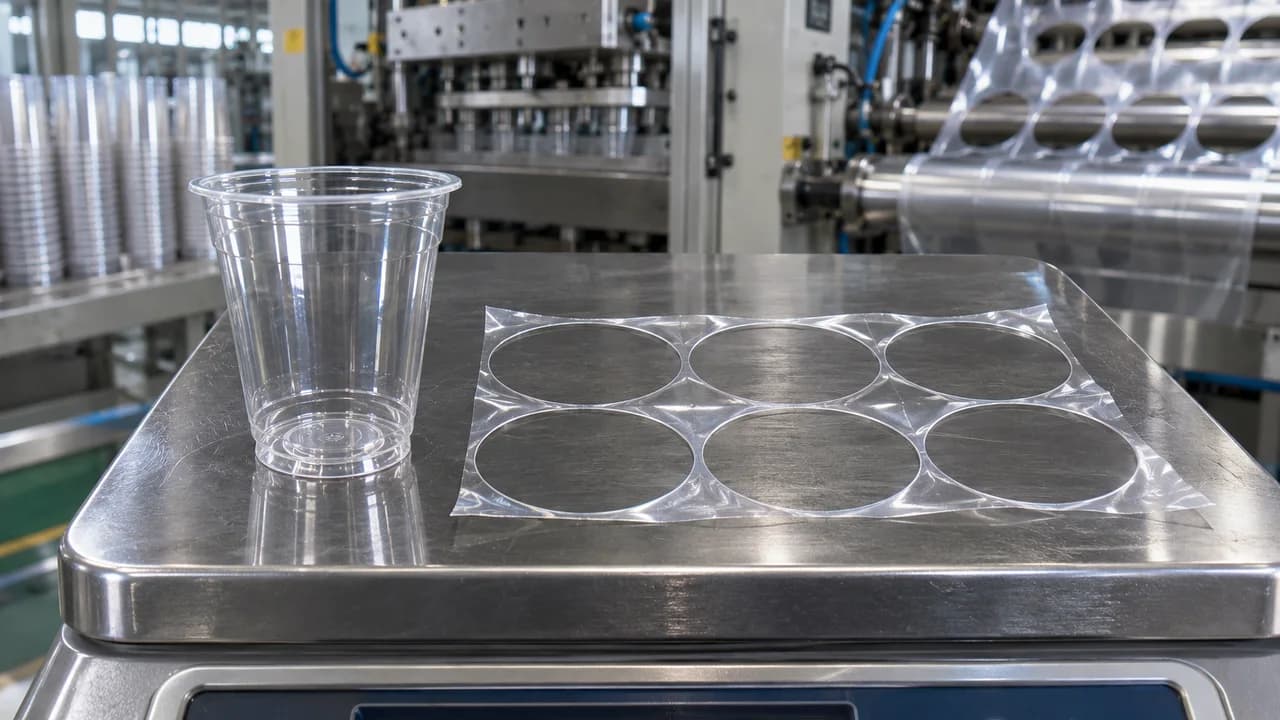
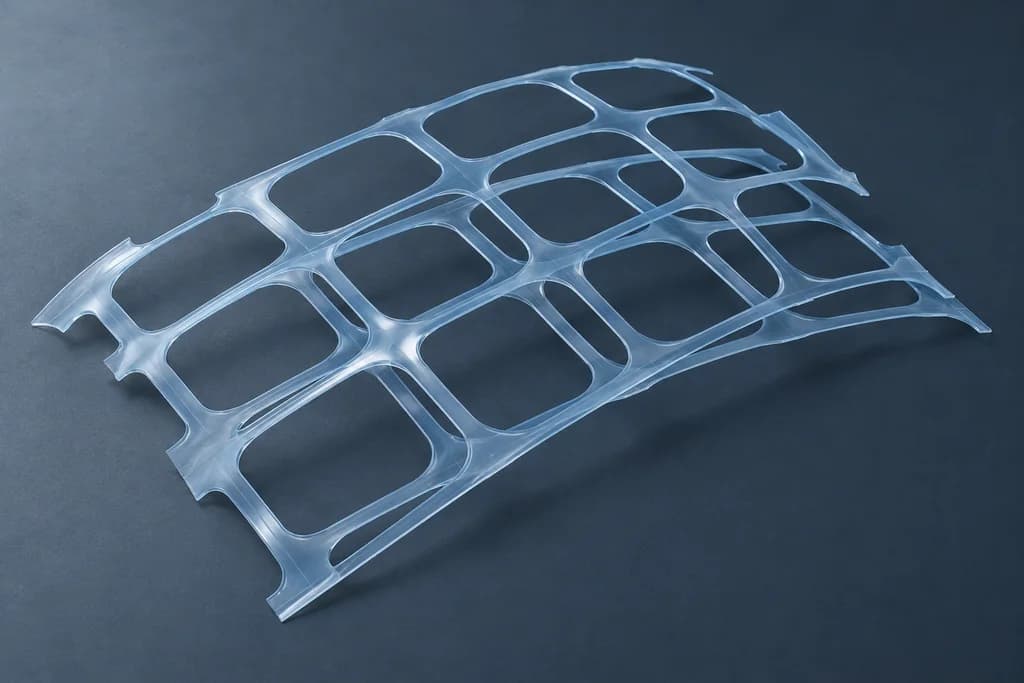
A cup count tells the buyer how many parts leave the stacker. The granulator receives the sheet left between those parts. Take a retained sample from a documented run. Lay it flat and identify the distance the sheet advances in one index. Include the full width, even when the outer rails carry most of the weight.
For a light web, weigh several complete repeats together in a tared container and divide by the number of indexes. For example, 20 repeats weighing 800 g give 40 g per index. Record the cup tool, cavity count, resin and sheet gauge with the sample. Use the actual index rate from that run.
Find the tool that sets the running load
Consider two hypothetical tools. Tool A leaves 40 g at 25 cycles/min, or 60 kg/h. Tool B leaves 32 g at 35 cycles/min, or 67.2 kg/h. The lighter skeleton puts more material through the granulator each hour. Taking the heavier skeleton and multiplying by the faster speed would describe a third recipe that the line may never run.
AMT connects cup output, sheet demand and scrap return in its line planning guide. Cumberland describes infeed options for scrap from startup through production. For a supplier trial, give both sets of data together: the mass rate at steady production and the shape that must pass through the inlet at startup.
Reconcile the estimate with a timed collection
At 60 kg/h, five minutes of steady production should yield about 5 kg. Start and finish with similar material levels in the collection path. Record any stops, loose rejects, diverted scrap or material left in transit. If the weighed mass differs, reconcile those entries before changing the design load.
Send Xufe the worksheet together with the widest full-width skeleton, maximum formed height during startup and proposed collection route. Agree with the equipment supplier on a trial for each difficult condition and record whether material accumulates while the forming line runs.
Feed path comparison
Continuous web
Trim station → web inlet → weighed regrind
Specify kg/h at each tool’s actual index rate.
Loose cup rejects
Stacker → segregated bin → approved batch inlet
Specify kg per batch and the time allowed to clear it.
| Measured input | Cup tool A | Cup tool B |
|---|---|---|
| Mass of 20 skeleton repeats | 800 g | 640 g |
| Mass per index | 40 g | 32 g |
| Running rate | 25 cycles/min | 35 cycles/min |
| Calculated web load | 60 kg/h | 67.2 kg/h |
| Expected five-minute sample | 5 kg | 5.6 kg |
Trial workflow
Sample
Retain full-width skeleton from a named cup tool.
Weigh
Divide net mass by the number of complete repeats.
Calculate
Apply the index rate measured on that recipe.
Verify
Compare with a timed collection and log diversions.
Frequently asked questions
Can I use cups per minute in the formula?
Use indexes per minute. If each index produces eight cups and all cavities operate, 200 formed cups per minute correspond to 25 indexes per minute. Packed cup counts can exclude rejects.
Does a shift average describe the infeed load?
Stops reduce the shift average. Use the running rate for the web and report the largest separate reject batch with its delivery time.
Is the calculated load a CXF capacity rating?
It describes the scrap produced by the cup tool. The proposed machine still needs a trial with your material, feed geometry, screen and discharge arrangement.
References
Related equipment and guides
- Thermoforming Granulator Sizing
- CXF Series
- How to Feed Thermoforming Skeletal Web into an Inline Granulator