
Production scrap · Engineering guide
How to Specify Traction Control for Indexed Thermoforming Sheet
Define the trim press and granulator handshake, size the usable slack window and verify the response to an interrupted index.
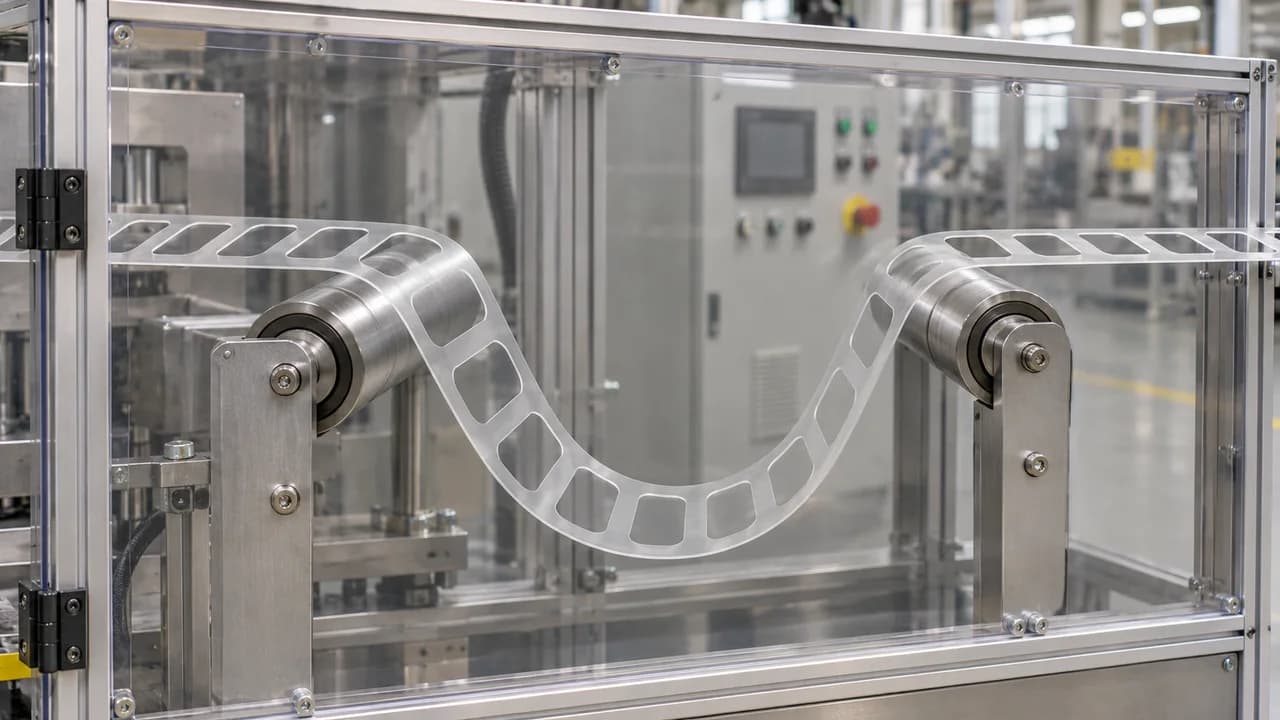
TL;DR · Quick answer
Measure the sheet advance and dwell for each index, then agree on how the feeder follows the press or uses a controlled slack loop. Specify which controller owns each signal, when it becomes stale and what each machine does at the slack limits. At acceptance, log an interrupted or delayed index, traction loss and controlled restart using production scrap.
Measure the index and the dwell separately
Log sheet advance in mm, cycle time and the duration of motion. For example, an index of 480 mm every 2.0 seconds averages 14.4 m/min. If the advance takes 0.5 seconds, the average speed during motion is 57.6 m/min, and the actual peak may be higher. These values describe a hypothetical press cycle. Capture the real speed profile when checking the proposed drive and controls.
If downstream uptake averages 240 mm/s, it collects 120 mm during that 0.5-second advance. The loop temporarily gains 360 mm of web length. Over the remaining 1.5 seconds, it gives that length back. Treat 360 mm as the example swing in stored sheet length. Convert it to the usable travel of the proposed loop geometry and allow engineering margin for delay, braking and material variation.
Assign each signal and agree on what it means
Rapid documents stand-alone loop control on a ThermoPRO example. ZERMA describes an infeed that regulates tension and speed with torque sensing. Rapid’s September 2026 Fakuma announcement also describes a roller feeder for continuous trim. For an indexed line, ask how the proposed control method handles dwell, missing motion and a restart. Each supplier should sign off the sequence for its own equipment.
Use the handoff table to turn each functional signal into a tagged interface with a sender and receiver. Document the valid state, timeout, permitted delay and response on loss. Process signals coordinate production. Specify machinery safety functions separately with the responsible safety engineer and use the agreed guarded test procedure.
Accept the interface against a time-aligned trace
Record the press index, feed enable, roller command and actual web motion where available, plus loop position or limits and fault feedback. Roller encoder movement on its own can miss web slip. Use agreed web marks or independent motion feedback when the acceptance criteria require proof of material travel.
With the widest and weakest production webs, log the normal sequence, a delayed or missed index as simulated through the approved test method, loss of tracking and a controlled restart. Enter measured response times and slack positions beside the agreed limits. Escalate any unexpected movement or automatic restart to the responsible integrator before signing off. Send the trace and signal list with the CXF line brief.
Feed path comparison
Press-synchronised traction
Press index → coordinated feeder motion → measured web travel
Verify response delay, actual sheet travel and behavior during the dwell.
Controlled slack loop
Press index → temporary web storage → controlled uptake
Verify usable stored length, slack limits and the stop response if either machine falls behind.
| Function and owner | Event to witness | Acceptance record |
|---|---|---|
| Index or motion status · press controller | Index is delayed, skipped or no longer valid | Expected response ___ · measured delay ___ ms · pass ___ |
| Available or stop request · feeder controller | Feeder becomes unavailable during an index | Upstream response ___ · measured delay ___ ms · pass ___ |
| Slack limits · loop controller | Loop approaches either approved operating limit | Measured slack ___ mm · agreed limit ___ mm · pass ___ |
| Traction feedback · feeder controller | Roller command and material travel diverge | Measured travel difference ___ mm · response ___ · pass ___ |
| Reset and restart · agreed owner | Fault cleared and line ready for controlled restart | Required acknowledgement ___ · observed sequence ___ · pass ___ |
Trial workflow
Measure the cycle
Record motion and dwell at normal and maximum recipes.
Assign the handoff
Name the owner, timeout and expected state for each signal.
Witness fault response
Use the approved test sequence with a representative web.
Sign off the trace
Store the signal timing, limits and restart result with the line drawing.
Frequently asked questions
Can I size the feed roller from average line speed?
Use the advance profile, dwell and maximum recipe. A feeder following the press sees the motion interval, while a controlled loop needs enough usable stored length to absorb the difference.
What confirms that the sheet has actually moved?
Use agreed web marks or independent motion feedback. Roller speed shows roller movement and can differ from sheet travel if the web slips.
Who defines the restart sequence after a missed index?
The press builder and feeder or granulator supplier agree the process handoff with the integrator. The responsible safety engineer specifies the safety functions and validates the guarded test method.
References
Related equipment and guides
- CXF Series
- How to Feed Thermoforming Skeletal Web into an Inline Granulator
- Thermoforming Scrap Recycling
- How to Test PET, PP and PS Sheet Scrap in an Inline Granulator